
An FUE transplant can look alarming before the follicles begin producing visible growth, but worsening pain, pus, fever, or spreading redness needs prompt medical attention. You will be able to place your result on the correct timeline, prepare a useful surgeon review, and decide whether you need observation, medical treatment, a second opinion, or delayed repair.
Key takeaways
- Judge FUE growth after the planned review period, not during early shedding.
- Contact your surgeon promptly for worsening pain, spreading redness, pus, or fever.
- Bring dated photos, medication details, and a timeline of symptoms to follow-up.
- Confirm the cause before starting medication or planning corrective surgery.
When can you fairly judge an FUE result?
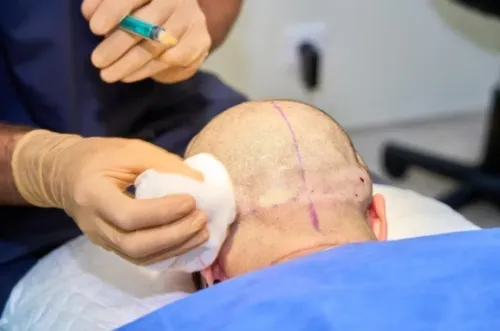
You cannot fairly judge an FUE result immediately after surgery. Early swelling, redness, tightness, numbness, crusting and scabbing can make the recipient area look uneven or sparse, while the donor area may also appear patchy.
| Time after FUE | What you may see | How to interpret it |
|---|---|---|
| Days 1–14 | Swelling, redness, tightness, numbness, crusts and scabs | Healing changes, not final density |
| Weeks 2–12 | Shedding of transplanted shafts and nearby native hairs | Shock loss can be temporary; miniaturising native hairs may not fully recover |
| Months 3–4 | Fine, uneven new hairs beginning to appear | Early regrowth, not the finished result |
| Months 6–12 | Increasing density and thicker hair calibre | A useful period for assessing progress against the plan |
| Months 12–18 | Continued thickening and maturation | Some results need this long before fair assessment |
A low-density appearance during the first weeks, or even the first few months, does not prove graft failure. Visible regrowth often begins around months 3 to 4, while density and hair calibre improve through months 6 to 12; maturation can continue to 12 to 18 months.
For FUE transplant result concerns, compare standardised photographs taken with the same lighting, angle, distance and hair length, then check them against the original operative plan and review interval. Ask the surgeon whether growth, native-hair shedding and density remain within the expected window before considering corrective treatment.
Which symptoms require your surgeon’s prompt review?
Contact the operating surgeon promptly if pain is worsening instead of improving, or if redness and warmth spread beyond the recipient area. Seek urgent medical evaluation for fever, rapidly increasing swelling, pus or foul-smelling drainage, bleeding that continues despite the instructed pressure, or rapidly worsening skin discoloration.
| Symptom | What it may indicate | What to do |
|---|---|---|
| Worsening pain, spreading redness or warmth | Infection or significant inflammation | Contact the operating clinic promptly |
| Pus, foul drainage or fever | Possible postoperative infection | Seek prompt clinical assessment |
| Rapid swelling or worsening discoloration | Another postoperative complication | Contact the surgeon or seek urgent care |
| Persistent bleeding | Bleeding requiring review | Apply only instructed pressure, then call the clinic |
| Severe itching | Irritation, inflammation or infection | Ask the surgeon before applying anything |
Follow your FUE aftercare surgeon advice before changing washing, medication, exercise, scab care or products. Do not pick crusts, resume strenuous activity, or start internet-recommended treatments without clinical advice; these actions can irritate the recipient area or dislodge grafts.
Sudden loss of existing hair also deserves review. Shock loss can affect nearby native hair, and miniaturising hairs may not recover even when transplanted grafts remain viable. Send photographs and describe the timing, rather than assuming every shed hair represents graft failure.
What should you bring to a hair transplant surgeon follow-up?
Bring a dated record to your hair transplant surgeon follow up, because memory cannot show whether symptoms improved or worsened.
1. Write down the surgery date and when swelling, crusting, shedding and regrowth began. Record pain severity, drainage, fever and itching, plus every medicine used, smoking, illness and any departure from the written aftercare instructions.
2. Take photographs from the front, both sides, top and donor area. Match the earlier images for lighting, camera distance, angle, hairstyle and hair length; otherwise changes in density can be mistaken for changes in the result.
3. Request copies of the operative report, total graft count, graft distribution by zone, donor and recipient areas treated, punch size, graft-storage details, extraction notes and implantation notes. Also request prescribed medicines, written aftercare instructions and planned review dates.
4. Ask whether growth is within the expected window, whether native hair is miniaturising and whether graft survival can be assessed yet. Ask which finding would trigger treatment or another review, and request that the answers and examination findings be documented.
Take the same photographs at each review. If the original clinic cannot provide operative records or a clear examination, seek an independent hair-restoration surgeon who personally performs surgery rather than relying on a salesperson’s reassurance. Do not begin corrective treatment or change aftercare before that assessment.
How do you identify the actual cause of a disappointing result?
A reliable diagnosis comes from examining your scalp alongside standardised photographs and operative records, not from judging density in a mirror. The comparison separates delayed growth from low graft survival, ongoing androgenetic alopecia, shock loss, an unnatural hairline, incorrect graft direction, visible donor scarring, or expectations that exceeded the planned graft supply.
- Compare photographs taken before surgery and at review with matching lighting, camera distance, angles, hair length and hairstyle. This can reveal excessive spacing, wrong angulation, visible multi-hair grafts at the hairline, an overly straight or low hairline, recipient scarring, or genuine delayed growth.
- Check the operative report for grafts harvested and implanted, distribution by zone, punch size, extraction and implantation notes, graft-handling and storage details, and the diagnosis of your hair-loss pattern. These records show whether the plan could produce the density you expected.
- Examine the donor area as carefully as the recipient area. FUE is not scarless: dot scars, donor depletion, and a patchy moth-eaten appearance can result from extraction, while poor growth can relate to graft handling, storage, infection, poor healing, smoking, scalp disease, or missed aftercare.
- Ask whether the finding fits shock loss, continuing native-hair miniaturisation, inadequate donor supply, unrealistic planning, or a technical problem. Do not assign blame before examination; each cause requires a different response.
If you need a FUE hair transplant surgeon for poor results, request an assessment that covers both areas and the long-term hair-loss pattern. FUE transplant result concerns do not automatically justify another procedure; a repair consumes more donor follicles before the first result has matured.
What should you do before considering medication or corrective surgery?
After the review, choose the least invasive step that matches the finding rather than treating every disappointing appearance with surgery.
| Option | What it addresses | When it applies |
|---|---|---|
| Observation | Delayed follicle growth | The recipient area is healthy and still within its expected maturation window |
| Complication treatment | Infection, inflammation, scarring, or poor healing | Examination identifies a medical problem requiring treatment |
| Medical stabilisation | Continuing miniaturisation of native hair | Ongoing androgenetic hair loss threatens surrounding density |
| Camouflage | Visible spacing or unevenness | Fibres, styling, or a shorter haircut improve appearance while you wait |
| Delayed revision surgery | Density, hairline, direction, or scarring problems | Growth has matured and a surgeon confirms repair is feasible |
Finasteride and topical minoxidil require a qualified clinician’s review of your sex, age, pregnancy potential, medical history, contraindications, and possible side effects. Do not start or stop either drug solely because the transplant looks disappointing.
Further surgery should wait until a surgeon assesses donor density, donor miniaturisation, scalp and recipient scarring, recipient condition, and your long-term hair-loss pattern. Using more donor follicles too early can worsen depletion and restrict later options.
A hair transplant surgeon follow up should produce a documented explanation, not only reassurance that the hair is “still growing.” If communication has failed, choose an independent FUE hair transplant surgeon for poor results who personally performs hair-restoration surgery.
A Nashik reader can consider Smart Look Clinic for a surgeon-led assessment distinguishing delayed growth, ongoing loss, and a correctable technical problem.
Related service
Hair Transplant Permanent baldness or severe hair thinning can affect your look and confidence. At Smart Look Clinic, Dr. View service → |
Frequently asked questions
When can you fairly judge an FUE result?
Do not judge immediately after surgery. Swelling, redness, numbness, crusting, scabbing, early shedding, and temporary patchiness can change the appearance. Ask your surgeon when your specific result can be assessed at a planned follow-up.
Which symptoms require your surgeon’s prompt review?
Contact your surgeon promptly for worsening pain, spreading redness, increasing swelling, pus, fever, heavy bleeding, foul odour, or skin darkening. Follow the clinic’s urgent-care instructions if symptoms progress quickly.
What should you bring to a hair transplant surgeon follow-up?
Bring dated photographs from before surgery and during recovery, your procedure documents, medication and supplement details, aftercare products, and a written timeline of symptoms, shedding, pain, and healing changes.
How do you identify the actual cause of a disappointing FUE result?
Ask the surgeon to assess healing, graft survival, hair-growth timing, donor density, hair-shaft characteristics, ongoing hair loss, infection, scarring, and whether the planned density or hairline was realistic.
What should you do before considering medication or corrective surgery?
Obtain a diagnosis and wait for the appropriate assessment point. Discuss medication risks and benefits with your surgeon, confirm whether native hair loss is continuing, and request a documented corrective plan before making another procedure decision.