
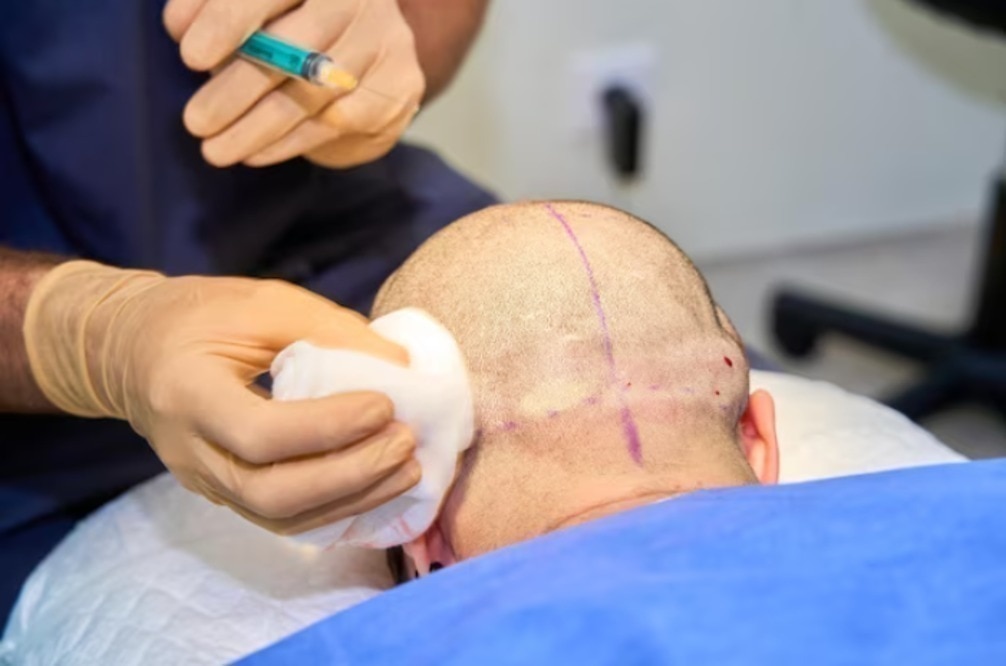
Uneven eyebrows can result from over-plucking, an old injury, natural asymmetry, or an active hair-loss condition, so counting grafts is not the first step. You will learn how FUE redistributes donor hair, which design and medical checks determine whether it can improve your brows, and what daily care and risks accompany the result.
Key takeaways
- Choose single-hair grafts that match natural eyebrow direction.
- Check thyroid disease, alopecia areata, scarring and overplucking first.
- Prioritise eyebrow shape and hair angle over graft count.
- Ask Nashik surgeons about donor selection, follow-up and revision planning.
How FUE redistributes hair into a sparse eyebrow
A stable difference in eyebrow density can be corrected by moving your own follicular units from a suitable donor area into the sparse brow. In FUE eyebrow restoration, the surgeon extracts individual units, usually selecting one-hair grafts or separating multi-hair units, then places them to fill a thin arch, head, or tail.
This creates targeted uneven eyebrow treatment rather than adding bulk across the entire brow.
The donor area must be examined before counting grafts. The clinician should measure density, check for miniaturisation, estimate the likely number of one-hair grafts, and protect the finite scalp supply. Overharvesting the scalp for a small cosmetic correction creates a second visible problem.
Before surgery, investigate these causes of sparse eyebrows:
- Repeated plucking or traction
- Alopecia areata
- Thyroid disease
- Dermatitis
- Nutritional deficiency
- Medication effects
- Scarring alopecia
| Situation | What FUE can do | What it cannot do |
|---|---|---|
| Stable, localised thinning | Add your own hairs to the deficient area | Guarantee an identical match to native brow texture |
| Active inflammatory or autoimmune loss | Provide coverage after the condition is controlled | Treat the underlying disease or prevent further loss |
| Insufficient or miniaturised donor hair | Allow a limited, conservative repair | Create unlimited density without risking overharvesting |
The result depends on disease stability as much as graft placement. If the cause remains active, transplanted and existing eyebrow hairs can both be lost.
Why eyebrow design matters more than graft numbers
A natural result is judged by brow direction, angle and facial balance, not by graft count. Eyebrow hairs lie almost flat against the skin, so the implantation angle must remain shallow.
Their direction changes along the brow, and a technically successful graft placed too upright or in a uniform line can look like bristles or plugs.
The surgeon should use mostly one-hair follicular units, separating multi-hair units before implantation. A multi-hair graft in a narrow brow can create a dense, painted-on patch. Recipient-site design must follow your existing brow and facial landmarks rather than forcing both eyebrows into mirror-image shapes.
- Soften density near the inner brow instead of creating a blunt, square edge.
- Follow the changing direction of native hairs rather than placing every graft parallel.
- Taper the outer brow so the tail does not end in a heavy, artificial block.
- Aim for facial balance, because natural eyebrows can differ in height, arch and tail length.
Scalp hair remains scalp hair after transplantation: it usually grows faster and longer than native eyebrow hair. Regular trimming becomes part of maintenance, so ask to see healed results rather than only immediate postoperative photographs. That trade-off belongs in any honest assessment of eyebrow hair transplant benefits.
Which causes of eyebrow loss must be checked first
FUE is unsuitable until the reason for uneven eyebrow density has been identified and stable. A transplant redistributes donor hair; it does not stop an active disease from damaging existing or newly implanted follicles. Starting an uneven eyebrow treatment too soon can lead to renewed loss, wasted grafts and an inaccurate eyebrow design.
| Cause | Why FUE must wait | What to establish first |
|---|---|---|
| Plucking or traction | Continued pulling can damage follicles and recreate the sparse area | Stop the habit and confirm the density has remained unchanged |
| Alopecia areata | New patches can appear after implantation | Obtain a diagnosis and document stable disease |
| Thyroid disease | Uncontrolled disease can contribute to ongoing shedding | Review thyroid treatment and confirm medical control |
| Dermatitis | Inflammation can impair healing and cause further loss | Identify the condition and settle active irritation |
| Nutritional deficiency | Low iron or other deficiencies can sustain shedding | Investigate the suspected deficiency and correct it |
| Medication effect | The offending medicine can continue the loss pattern | Review every prescription, supplement and recent change with the prescriber |
| Scarring alopecia | Destroyed follicles cannot be revived by transplant, and active scarring can spread | Confirm the diagnosis and demonstrate inactive disease |
Ask whether the diagnosis comes from examination alone or requires dermatology assessment. Do not stop a prescribed medicine without the prescribing clinician’s advice.
Fue eyebrow restoration becomes more reasonable when the defect has a clear cause, the skin is healthy, and density has remained stable long enough for the surgeon to plan one-hair graft placement rather than chase a moving target.
What recovery, maintenance and risks should you expect
Expect temporary swelling, redness and tenderness around the brows after FUE. Crusting can make the area look worse before it settles, and transplanted hairs may shed before new growth appears. Results are delayed, so do not judge density during the early healing phase.
| Factor | Practical benefit | Trade-off to accept |
|---|---|---|
| One-hair grafts | Finer control over direction and spacing | More careful placement and a limited donor supply |
| Scalp donor hair | Adds density using your own tissue | It keeps scalp growth behaviour and needs regular trimming |
| Selective placement | Rebuilds a missing arch or tail | A correction or second procedure may be needed |
| Stable defect | Can provide long-lasting density | It does not guarantee a permanent match to native brow hair |
Maintenance is part of the decision: scalp-derived hairs often grow longer and faster than eyebrow hairs, so you may need frequent trimming and shaping. Protect the donor area from overharvesting; the scalp supply is finite, and a cosmetic brow procedure should not compromise future restoration.
Possible complications include bleeding, infection, prolonged redness, ingrown hairs, cysts, visible scarring, poor growth, unnatural hair direction and revision surgery. Multi-hair grafts that are not separated can create a thick, pluggy look. A small punch reduces the extraction size, not the risk.
The eyebrow hair transplant benefits are strongest when the defect is stable, the donor area is healthy and you accept ongoing grooming.
How to assess a FUE eyebrow surgeon in Nashik
A credible comparison starts with the doctor, not the clinic’s location or gallery. For a search such as “FUE hair transplant for surgeon uneven eyebrow density in Nashik,” verify the named practitioner’s medical licence, who performs extraction and implantation, and whether the surgeon personally plans hair angle, direction and graft placement.
1. Ask for a donor assessment, including density, scalp miniaturisation and the estimated number of one-hair grafts required. The plan should protect your finite donor supply and reject overharvesting for a small cosmetic correction.
2. Confirm specific eyebrow experience, not only scalp transplant experience. Ask to see appropriately consented photographs of healed results, including front, oblique and close views; immediate postoperative images cannot show final direction, spacing or thickness.
3. Ask how the surgeon will separate multi-hair follicular units. Implanting them intact can create a thick, pluggy eyebrow, while one-hair grafts allow finer reconstruction of a missing arch or tail.
4. Check the diagnostic process before agreeing to surgery. Plucking or traction, alopecia areata, thyroid disease, dermatitis, nutritional problems, medication effects and scarring alopecia require attention, and active inflammatory or autoimmune loss can affect transplanted hair.
5. Ask who handles follow-up, trimming guidance, delayed growth and possible revision. When comparing SMART LOOK CLINIC with another FUE hair transplant surgeon in Nashik, use these documented answers—not advertising language—as your comparison record. A good plan explains what FUE cannot guarantee: an exact permanent match to native eyebrow hair.
Frequently asked questions
How does FUE redistribute hair into a sparse eyebrow?
The surgeon extracts individual follicular units from a donor area and places selected one-hair grafts into the thin brow region.
Why does eyebrow design matter more than graft numbers?
A natural result depends on the arch, head, tail, hair direction and density gradient, not simply the number of grafts.
Which causes of eyebrow loss should be checked first?
Check for overplucking, thyroid disease, alopecia areata, skin conditions, scarring and medication-related loss before surgery.
What recovery, maintenance and risks should you expect?
Expect temporary redness, swelling, shedding and careful washing; risks include poor growth, unnatural direction, infection and the need for revision.
How can you assess an FUE eyebrow surgeon in Nashik?
Review eyebrow-specific before-and-after cases, confirm the surgeon performs the procedure, and ask about graft planning, follow-up and complications.