
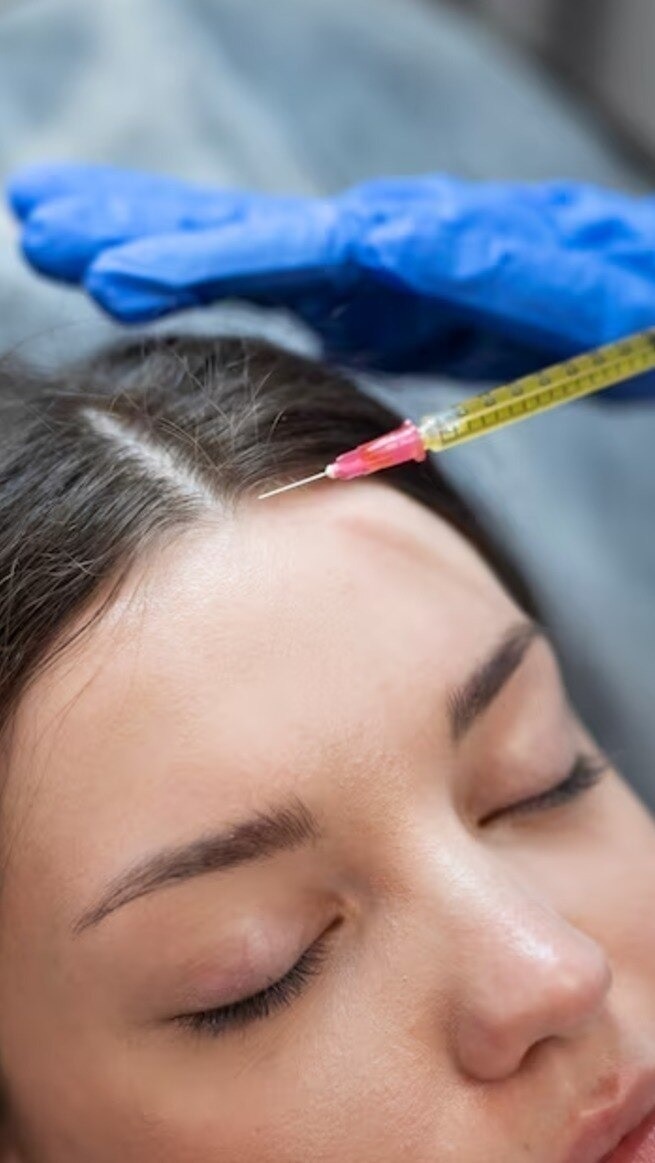
Redness, itching, scaling, pain, pustules, and sudden shedding do not identify one scalp disorder, so injecting platelet-rich plasma before finding the cause can delay the right treatment. By the end, you will know when PRP should be postponed, which diagnoses have supporting evidence, what a proper consultation should check, and how to judge whether the proposed treatment is reasonable.
Key takeaways
- Diagnose redness, scale, pustules, or sudden shedding before booking PRP.
- Treat active infection or inflammation before deciding whether PRP is suitable.
- Ask for the diagnosis, proposed protocol, risks, and measurable review dates.
- Track shedding, scalp symptoms, and photographs against a baseline.
Diagnose the inflamed scalp before considering PRP
Redness, scale, itching, pain, pustules, or sudden shedding is a diagnostic problem before it is a PRP problem. Seborrhoeic dermatitis, psoriasis, bacterial or fungal folliculitis, alopecia areata, and scarring alopecias can look similar but require different treatment.
The decision about prp hair treatment for scalp inflammation in nashik should begin with identifying the cause, not with scheduling injections.
1. Take a focused history. Report when shedding began, whether it is sudden, and any pain, pus, broken hairs, heavy scale, or smooth bald patches. Include family-pattern hair loss, medicines, bleeding disorders, autoimmune disease, and previous scalp treatments.
2. Expect a scalp examination with dermoscopy and, when useful, a hair-pull test. Dermoscopy can reveal scaling, follicular openings, broken hairs, or scarring that is not obvious in a mirror.
3. Request targeted testing when the findings support it. A clinician may order fungal microscopy or culture, bacterial testing, or a scalp biopsy. Blood tests should address a suspected cause rather than form an automatic PRP package.
4. Control active disease before reconsidering PRP. Anti-yeast treatment, corticosteroids, vitamin-D analogues, or keratolytics may be appropriate for diagnosed seborrhoeic dermatitis or psoriasis. Scarring disorders such as lichen planopilaris or frontal fibrosing alopecia need prompt anti-inflammatory care because follicle loss can be permanent.
PRP is not an established primary treatment for scalp psoriasis or seborrhoeic dermatitis. Do not let an injection plan delay disease-specific treatment or investigation of an infection.
PRP suitability depends on the diagnosed scalp condition
PRP has its strongest clinical support for androgenetic-pattern hair loss, where follicles remain alive but produce progressively thinner hairs. Searching for prp for scalp conditions in nashik does not change that evidence: suitability depends on the diagnosis, follicle viability, and whether active disease is controlled.
| Condition | Evidence for PRP | Appropriate role |
|---|---|---|
| Androgenetic alopecia | Best-supported scalp indication | Possible treatment after diagnosis and discussion of alternatives |
| Alopecia areata | Smaller, mixed studies | Adjunct to disease-specific treatment, not a replacement |
| Seborrhoeic dermatitis or scalp psoriasis | Not established as primary treatment | Treat with options such as ketoconazole, corticosteroids, vitamin-D analogues, or keratolytics according to diagnosis |
| Bacterial or fungal folliculitis | Insufficient evidence | Treat the infection first; do not use PRP instead |
| Scarring alopecia | Limited and heterogeneous evidence | Specialist-led adjunct only; scarred follicles will not regrow |
For prp hair treatment for scalp inflammation in nashik, redness, scale, itching, pain, pustules, or sudden shedding must not be treated as proof that PRP is appropriate. PRP cannot replace antifungal, anti-inflammatory, antimicrobial, or immunomodulatory treatment when those address the actual cause.
A scalp problem prp consultation in nashik should also assess dermoscopic signs of viable follicles and scarring. PRP is a poor choice when inflammation remains active, the diagnosis is uncertain, or hair loss reflects follicles permanently replaced by scar tissue.人體藝術
What a scalp problem PRP consultation should include
Expect a scalp diagnosis before anyone recommends an injection. A scalp problem PRP consultation in Nashik should establish whether redness, itching, scale, pain, pustules, or shedding comes from seborrhoeic dermatitis, psoriasis, folliculitis, alopecia areata, scarring alopecia, or pattern hair loss.
Your clinician should ask when shedding began, whether it was sudden, and whether you notice broken hairs, tenderness, pus, or shiny areas where follicles have disappeared. They should also review family-pattern hair loss, recent illness, pregnancy, diet, autoimmune disease, allergies, current medicines, bleeding history, platelet disorders, and anticoagulant or antiplatelet use.
- Expect inspection of the scalp and hair shafts, with attention to scale, redness, pustules, broken hairs, scarring, and follicle openings.
- A dermoscope can reveal miniaturised hairs, inflammation, broken shafts, or scarring; a hair-pull test can assess active shedding.
- Fungal or bacterial testing applies when the examination suggests infection. A scalp biopsy applies when scarring, alopecia areata, or another unclear disorder is suspected.
- Blood tests should target the suspected cause, such as iron deficiency or thyroid disease, rather than accompany every PRP consultation.
- Ask how active disease will be controlled, why PRP fits your diagnosis, what standard treatments and alternatives remain, and what discomfort or bleeding risk to expect.
At SMART LOOK CLINIC, ask for the proposed PRP protocol and a photograph or hair-density method for measuring change; never stop a clot-affecting medicine without its prescriber’s advice.
Judge the likely benefit, protocol, and risks before paying
Compare proposals by diagnosis, evidence, protocol, safety, and follow-up—not by the number of injections. For prp scalp treatment suitability in nashik, the likely benefit must justify repeated blood draws, needle discomfort, bruising, swelling, expense, and the risk of infection or worsening an undiagnosed condition.
| Comparison point | Strong proposal | Warning sign |
|---|---|---|
| Diagnosis and evidence | Names the hair-loss condition and explains where PRP has supporting evidence, strongest for androgenetic-pattern hair loss | Promises to treat every itchy, red, or shedding scalp |
| Protocol | Explains blood volume, preparation method, injection approach, session interval, and evidence for the plan | Treats one fixed schedule as mandatory or compares clinics only by injection count |
| Alternatives | Treats active dermatitis, psoriasis, infection, alopecia areata, or scarring disease with condition-specific care | Presents PRP as a replacement for antifungal, anti-inflammatory, or other standard treatment |
| Safety | Reviews medicines, bleeding disorders, platelet problems, infection, pregnancy, and other contraindications | Starts without checking medical history or examining the scalp |
| Measurement | Records standardized photographs or hair-density measurements before treatment | Relies on vague promises or an unplanned review |
A commonly studied plan uses three sessions about four weeks apart, followed by maintenance only when the response and evidence support it. PRP preparation varies between studies, so ask what result the clinic expects, when it will be assessed, and what happens if improvement is absent.
Delay treatment until active disease is controlled, the diagnosis is clear, alternatives are discussed, and a measurable stopping point is written down.
Use a clear decision standard and measurable follow-up plan
Start PRP only after active scalp disease is diagnosed and controlled, the hair-loss pattern is one for which PRP has supporting evidence, and standard treatment has been discussed. PRP is not a substitute for anti-inflammatory treatment in lichen planopilaris or frontal fibrosing alopecia, where delayed care can mean permanent follicle loss.
- Confirm the diagnosis, such as androgenetic alopecia, alopecia areata, seborrhoeic dermatitis, psoriasis, folliculitis, or a scarring alopecia. Do not proceed on “itchy scalp” or “hair fall” alone.
- Treat infection, scale, redness, pain, or active inflammation first. For scalp psoriasis or seborrhoeic dermatitis, discuss established options such as ketoconazole, corticosteroids, vitamin-D analogues, or keratolytics.
- Review platelet count, bleeding history, platelet disorders, and medicines including anticoagulants or antiplatelet drugs. Never stop these medicines for PRP without the prescribing clinician’s instruction.
- Record baseline photographs using the same camera, lighting, angle, hair length, and parting. Add a marked scalp area for hair-density assessment or dermoscopy, and write down the planned session number and review date.
- Measure change at each review using identical photographs, hair counts or dermoscopic density, shedding history, and symptoms. Judge progress at the agreed endpoint, commonly three to six months after the initial sessions, not after a few days.
- Stop or revise the plan if inflammation returns, scarring progresses, symptoms worsen, or objective density does not improve by the review date.
Frequently asked questions
Should you diagnose an inflamed scalp before considering PRP?
Yes. Redness, scale, itching, pain, pustules, or sudden shedding can indicate conditions needing diagnosis and treatment before PRP.
Is PRP suitable for every scalp condition?
No. Suitability depends on the diagnosis. Seborrhoeic dermatitis, psoriasis, folliculitis, alopecia areata, and scarring alopecias require different decisions.
What should a scalp problem PRP consultation include?
It should include a scalp examination, medical and hair-loss history, a working diagnosis, discussion of alternative treatments, and a proposed PRP protocol.
How can you judge whether PRP is worth paying for?
Ask what benefit is realistic, how many sessions are proposed, what risks apply, how progress will be measured, and when treatment will be reviewed.